Web Application Development Services
The dashboard loads. Slowly. A spinner appears, the one your team added 'temporarily' eighteen months ago. Your biggest client is on a video call, waiting. You make small talk about the weather while silently willing React to hydrate faster.
We build web applications where pushing to production is boring. Boring is the goal.
The problem
Sound familiar?
The jQuery inheritance
You inherited a codebase that started as a 'quick prototype' in 2018. It's now 400,000 lines of spaghetti that nobody fully understands. The original developer left two years ago.
The deployment dread
Every deploy is a team ceremony. Someone watches the logs. Someone else has the rollback script ready. Friday deploys are forbidden by unwritten law.
The scaling cliff
Your app works fine for 100 users. At 1,000 it slows. At 5,000 it falls over. Your architecture was designed for launch day, not growth.
The feature paralysis
Adding a new field to a form takes three sprints because everything is coupled to everything else. Your velocity is a fraction of what it was at launch.
Our approach
Here's how we fix this.
We build web applications where pushing to production is boring. Boring is the goal.
How we deliver
Our Web Development Process
Audit & architecture
Week 1-2We read your codebase before we judge it. Identify the load-bearing walls vs. the decorative ones. Map dependencies. Find the 20% of changes that will solve 80% of your pain.
Foundation first
Week 2-3Set up the CI/CD pipeline, testing infrastructure, and deployment strategy before writing features. The boring work that makes everything after it fast.
Incremental delivery
Week 3-12Ship to staging every day. Ship to production every week. Small, reviewable PRs that your team can understand, not thousand-line monsters.
Performance & polish
Week 10-14Lighthouse audits, Core Web Vitals optimization, accessibility compliance. The difference between a web app and a great web app.
Handoff & ownership
Week 14Documentation that developers actually read. Architecture decision records. Your team can iterate on day one without calling us.
What you get
Web Development Features & Deliverables
Production web application
Fast, accessible, deployed with confidence
Automated test suite
Catch regressions before users do
CI/CD pipeline
Merge to main, deploy to production, automatically
Performance monitoring
Real user metrics, not synthetic benchmarks
Component library
Consistent UI that scales with your team
Architecture documentation
New engineers productive in days, not weeks
Proof, not promises
We've done this before.
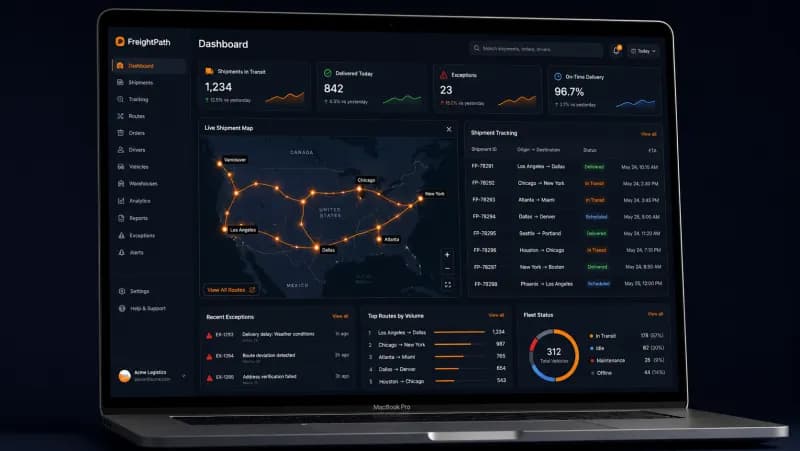
FreightPath Logistics
The situation
FreightPath operated a 12-year-old PHP monolith (Laravel 5.4, never upgraded) that powered shipment tracking, carrier management, rate quoting, and invoicing for 800+ logistics customers. The system processed 45,000 shipments monthly but page loads averaged 11 seconds, the rate quoting engine crashed under concurrent load, and their single MySQL instance was hitting I/O ceiling every afternoon. After an acquisition by a larger logistics group, they needed multi-tenant architecture within 6 months or face a $2.4M integration penalty in the deal terms.
Technical challenge
The monolith had 480K lines of PHP with zero test coverage, business logic embedded in Blade templates, and a 200-table MySQL database with no foreign keys (integrity maintained by application code that frequently failed). The rate quoting engine made synchronous calls to 14 carrier APIs sequentially, a single timeout cascaded into full request failure. They needed multi-tenancy, real-time shipment tracking, sub-2-second page loads, and SOC 2 audit readiness, all without disrupting 800 active customers during migration.
What we did
Architected a Next.js 14 frontend with server components for the dashboard, reducing client-side JavaScript by 73% and enabling instant navigation between shipment views via streaming SSR
Decomposed the monolith into 6 domain services (Quoting, Tracking, Billing, Carrier Management, Customer Portal, Reporting) running as containerized Node.js services behind an API gateway
Built an async rate quoting engine using BullMQ that fans out to all 14 carrier APIs in parallel with circuit breakers, quotes now return in 900ms average instead of 34 seconds
Migrated from single MySQL to PostgreSQL with row-level security for multi-tenancy, implementing a strangler fig pattern that ran both systems in parallel for 8 weeks with automated consistency checks
Implemented real-time shipment tracking via WebSocket connections with Redis pub/sub, updating positions every 30 seconds for active shipments across all tenant dashboards simultaneously
Results
Average Page Load
Rate Quote Response Time
System Uptime
Monthly Shipment Capacity
Customer Onboarding Time
Support Tickets (system issues)
Technologies
 Next.js
 TypeScript
 Node.js
 PostgreSQL
 Redis
Redis BullMQ
 Docker
 AWS ECS
 Prisma
 WebSocket
 Terraform
 Datadog
Their communication was consistent, and they were flexible when requirements evolved. CodeMiners delivered 100% of the agreed core functionality and launched our platform on schedule with a stable UX.
Tech stack
Built on what works.



Web Development Pricing
Transparent, fixed-price packages. No hidden fees. 65% below comparable US agency rates.
Business Website
1–3 weeks delivery
Professional websites for businesses that need an online presence fast.
- ✓5–15 pages with responsive design
- ✓CMS (WordPress or custom)
- ✓Contact forms and lead capture
- ✓Basic SEO setup and sitemap
- ✓Mobile-first design
- ✓SSL and hosting setup
- ✓30 days post-launch support
Web Application
6–14 weeks delivery
Custom web apps with user accounts, dashboards, and business logic.
- ✓User authentication and roles
- ✓Custom dashboards and analytics
- ✓API integrations (payment, CRM, etc.)
- ✓Database design and optimization
- ✓CI/CD pipeline setup
- ✓Automated testing suite
- ✓Real-time features (if needed)
- ✓60 days post-launch support
SaaS Platform
10–20 weeks delivery
Full-scale platforms with billing, multi-tenancy, and enterprise features.
- ✓Multi-tenant architecture
- ✓Subscription billing (Stripe)
- ✓Admin panel and analytics
- ✓API documentation
- ✓Scalable cloud infrastructure
- ✓Security audit and compliance
- ✓Performance optimization
- ✓90 days post-launch support
- ✓Dedicated project manager
All prices are fixed-price estimates. Final quote provided within 4 hours of consultation. No hourly billing surprises.
Traditional Agency vs. CodeMiners
See why 200+ companies chose CodeMiners over traditional alternatives
| Feature | Traditional US Agency | CodeMiners |
|---|---|---|
| Hourly Rate | $150–$300/hr | $35–$55/hr equivalent |
| Business Website | $8,000–$25,000 | $300–$1,200 |
| Custom Web App | $25,000–$100,000 | $1,500–$8,000 |
| Time to First Deliverable | 4–6 weeks | 1–2 weeks |
| Communication | Account manager (indirect) | Direct access to developers |
| Project Visibility | Monthly status calls | Daily progress + sprint demos |
| Post-Launch Support | $200+/hr retainer | Included (30–90 days) |
| Tech Stack | Whatever they specialize in | Matched to your requirements |
| Pricing Model | Hourly (unpredictable) | Fixed price (quoted upfront) |
| Team Size | 1–2 people on your project | Dedicated team (3–6 people) |
Web Development FAQ
Common questions about our web development services
Web Development Resources
Web Development Guides & Insights
In-depth guides to help you plan, budget, and execute your web development project.
Web App Development Cost Guide
Complete cost breakdown for web application development.
Read guideBest Tech Stack for Startups
Choosing the right technology stack for your startup.
Read guideNext.js vs Remix Comparison
Comparing the top React meta-frameworks.
Read guideE-Commerce Development Guide
Building online stores and e-commerce platforms.
Read guideBook a Free 30-Minute Call with Us
No sales pitch. Discuss your project, get honest advice, and a fixed-price quote within 4 hours.
Ready to start?
Your web app should load before your users finish blinking. Let's make that happen.