SLA & Maintenance
The feature shipped six months ago. Since then: two critical bugs, one performance regression, and a dependency that was deprecated without anyone noticing. Your users adapted, they found workarounds. They stopped reporting issues. They started looking at competitors. Silence is not satisfaction. Silence is resignation.
We maintain your software with the care of people who built it, because we probably did.
The problem
Sound familiar?
The silent rot
Dependencies go out of date. Security patches pile up. Performance degrades imperceptibly, 50ms here, 100ms there, until one day it's just slow and nobody knows when it started.
The abandoned codebase
The original team moved on to the next project. The new team inherited code they don't understand. Bug fixes take 3x longer because nobody knows the context.
The 'it works' denial
No crashes doesn't mean no problems. Your users have simply learned to avoid the broken parts. They navigate around bugs like drivers avoiding potholes, functional but eroding trust daily.
The compliance cliff
Your app hasn't been updated in 18 months. It's three versions behind on its framework. One day you'll need to pass a security audit and discover you need a full rewrite to comply.
Our approach
Here's how we fix this.
We maintain your software with the care of people who built it, because we probably did.
How we deliver
Our SLA & Maintenance Process
Health assessment
Week 1We audit your codebase for security vulnerabilities, outdated dependencies, performance regressions, and technical debt. You get a prioritized report of what needs attention now vs. later.
Stabilization sprint
Week 1-3Address critical security issues, update deprecated dependencies, fix the bugs your users stopped reporting. Bring the codebase to a healthy baseline.
Ongoing maintenance rhythm
OngoingRegular dependency updates, proactive security patching, performance monitoring, and a dedicated point of contact who knows your codebase intimately.
Guaranteed response times
OngoingSLA-backed response windows: critical issues within 2 hours, high-priority within 8, standard within 24. Measured, reported, and held to.
Quarterly health reviews
QuarterlyRegular check-ins on codebase health, performance trends, and upcoming risks. You're never surprised by 'we need a rewrite.'
What you get
SLA & Maintenance Features & Deliverables
SLA-backed response times
Critical: 2h. High: 8h. Standard: 24h. Guaranteed.
Proactive dependency management
Never fall more than one major version behind
Security vulnerability scanning
CVEs caught and patched before they become incidents
Performance trend monitoring
Degradation caught at 50ms, not 5 seconds
Quarterly health reports
Clear picture of technical debt trajectory
Bug fix budget (hours/month)
Known capacity for addressing issues, not ad-hoc scrambles
Proof, not promises
We've done this before.
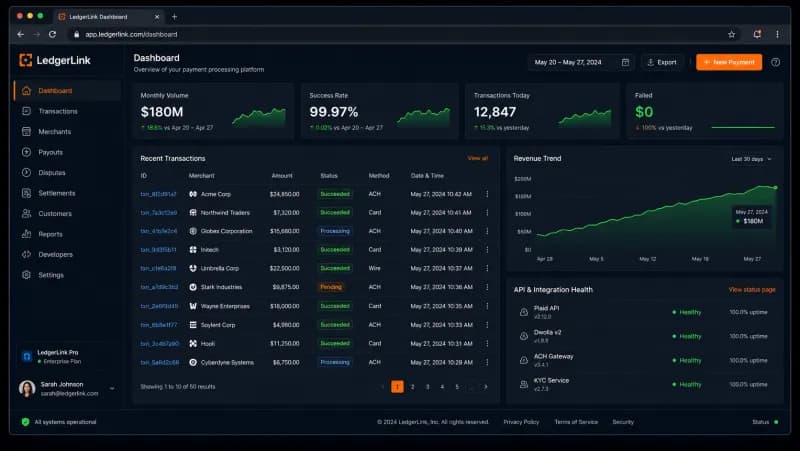
LedgerLink
The situation
LedgerLink processes ACH and wire transfers for 340 mid-market businesses, handling $180M in monthly payment volume. Their platform hadn't received meaningful maintenance in 18 months, the previous engineering team was laid off during a cost-cutting round and remaining devs focused exclusively on new features. Three critical third-party APIs were approaching end-of-life: Plaid's legacy endpoint (sunsetting in 90 days), Dwolla v1 (deprecated), and their KYC provider's SDK (2 major versions behind with known CVEs).
Technical challenge
Node.js runtime on v14 (EOL), 67% of npm dependencies had known vulnerabilities, and zero automated testing. The Plaid legacy endpoint was sunsetting in 90 days with no migration path documented internally. Dwolla v1's async status model differed fundamentally from v2, requiring a full rewrite of the transfer reconciliation flow. One wrong deprecation could halt $180M in monthly payments. Constraint: zero downtime during migration, regulated financial transactions cannot be interrupted.
What we did
Conducted a full dependency audit identifying 214 vulnerable packages, 3 critical API deprecations, and 12 breaking changes required for the Node.js 14 to 20 migration, prioritized by blast radius and deadline urgency
Migrated Plaid integration from legacy /transactions endpoint to the new Sync API, rewriting webhook handling and implementing idempotent transaction reconciliation, completed 6 weeks before sunset deadline with parallel validation against production data
Upgraded Dwolla from v1 to v2 API with new webhook verification, updated transfer flow to handle the new async status model, and built a comprehensive integration test suite using recorded API fixtures
Executed Node.js 14 to 20 migration in stages: dependency upgrades first, then runtime migration, then enabling new language features, with zero-downtime blue-green deploys and instant rollback capability at each stage
Established ongoing SLA-based maintenance contract: weekly dependency updates, monthly security patches, quarterly major upgrades, 4-hour critical response time, and proactive monitoring of all third-party API deprecation notices and changelog feeds
Results
Known Vulnerabilities (npm audit)
API Deprecation Risk
Node.js Version
Payment Processing Downtime (during migration)
Time to Patch Critical CVE
Automated Test Coverage
Technologies
 Node.js
 TypeScript
 Plaid API
 Dwolla API
 PostgreSQL
 Redis
Redis Jest
Jest GitHub Actions
 SnykDependabot
 Docker
 AWS ECS
Their communication was consistent, and they were flexible when requirements evolved. CodeMiners delivered 100% of the agreed core functionality on schedule with a stable, secure platform.
Tech stack
Built on what works.
DevOps
 SentryNNew Relic
Other
SLA & Maintenance FAQ
Common questions about our sla & maintenance services
Book a Free 30-Minute Call with Us
No sales pitch. Discuss your project, get honest advice, and a fixed-price quote within 4 hours.
Ready to start?
Preventive care costs less than emergency surgery. And it hurts a lot less. Let's keep your software healthy.