SEO & Digital Marketing
You Google your own company name and you're on page one. Good. You Google what your company actually does, the problem you solve, and you're nowhere. Page four. Behind a Reddit thread from 2021 and a competitor's blog post that is factually wrong but ranks beautifully.
We make your expertise visible to the people who are actively searching for what you offer.
The problem
Sound familiar?
The referral dependence
Your pipeline depends on who-knows-who. When referrals slow down, revenue slows down. You have no predictable source of strangers discovering you.
The content graveyard
You published 30 blog posts last year. None of them rank. None of them drive leads. They exist because someone said 'we should do content marketing' without a strategy behind it.
The paid media trap
You're spending $8K/month on ads. Your CAC is climbing. The moment you turn off spend, leads stop. You're renting attention instead of building equity.
The invisible expertise
You're genuinely great at what you do. Your clients love you. But nobody who hasn't been personally referred to you would ever know you exist. Your expertise is invisible online.
Our approach
Here's how we fix this.
We make your expertise visible to the people who are actively searching for what you offer.
How we deliver
Our SEO & Digital Marketing Process
SEO & market audit
Week 1-2Analyze your domain authority, keyword gaps, technical SEO issues, and competitor landscape. Identify the highest-leverage opportunities, where you can realistically win.
Keyword & content strategy
Week 2-3Map your expertise to what people actually search for. Prioritize commercial-intent keywords where you can rank in 3-6 months, not vanity terms that take years.
Technical SEO foundation
Week 2-4Fix crawl issues, site speed, internal linking, and structured data. The infrastructure that makes content rank.
Content production & optimization
OngoingCreate content that serves user intent, demonstrates expertise, and ranks. Every piece has a specific keyword target and conversion path.
Measurement & iteration
MonthlyMonthly reporting on rankings, traffic, and leads from organic. Adjust strategy based on what's actually working, not what 'should' work.
What you get
SEO & Digital Marketing Features & Deliverables
SEO audit & roadmap
Clear priorities based on impact, not guesswork
Keyword strategy & content calendar
Know exactly what to create and why
Technical SEO fixes
Remove the barriers between your content and Google
Content production (monthly)
Expert content that ranks and converts
Monthly performance reports
ROI visibility with rankings, traffic, and lead attribution
Competitor monitoring
Know when competitors move, and respond faster
Proof, not promises
We've done this before.
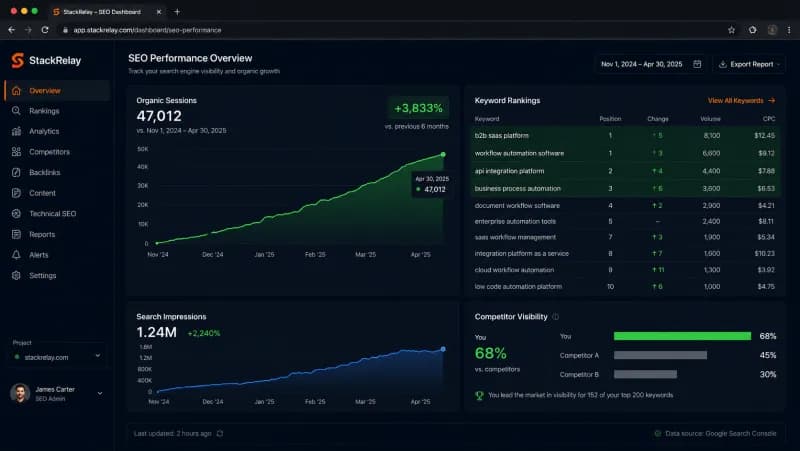
Snapdocs (fictional: StackRelay)
The situation
StackRelay builds API monitoring and debugging tools for backend engineering teams. Despite having a technically superior product (lauded in Hacker News comments and engineering blogs), they had zero organic search presence. 94% of their customer acquisition came from paid channels, Google Ads at $287 CAC, LinkedIn at $410 CAC, burning $120K/month on ads with no compounding return. Their blog had 11 posts (all product announcements nobody searched for), their documentation wasn't indexed, and they ranked on page 1 for exactly zero commercial keywords. Their Series A runway gave them 14 months, and the board demanded a path to CAC below $150 before the next raise.
Technical challenge
The website was a React SPA with client-side rendering, Google could barely crawl it (only 23 of 89 pages indexed). JavaScript-rendered content returned empty HTML to crawlers. The blog was on a subdomain (blog.stackrelay.com) with no domain authority connection to the main site. Page speed was poor (4.2s LCP) due to an unoptimized bundle. They had no keyword strategy, zero content mapped to the problems their buyers actually Google. Competitors (Datadog, Sentry, Postman) dominated every relevant SERP with massive content moats. StackRelay needed to find and own underserved keyword niches where they could realistically rank within 6 months despite a DR of 12.
What we did
Migrated from client-rendered React SPA to Next.js with SSR/SSG, implemented proper meta tags, canonical URLs, structured data, and XML sitemaps, indexed pages jumped from 23 to 156 within 4 weeks of relaunch
Conducted extensive keyword research identifying 340 underserved long-tail terms in the 'API debugging,' 'webhook testing,' and 'backend observability' clusters where top-ranking content was thin or outdated, mapped these to a 6-month editorial calendar
Produced 48 pieces of technical content over 6 months: in-depth comparison guides (StackRelay vs. Postman for API monitoring), problem-solving tutorials (debugging webhook failures, tracing distributed requests), and data-driven industry reports, each piece averaging 2,800 words with original diagrams
Built programmatic SEO pages for 1,200 integration-specific landing pages (e.g., 'Monitor Stripe Webhooks,' 'Debug AWS Lambda API Gateway Timeouts') using templatized content with unique technical details per integration
Implemented technical SEO infrastructure: moved blog to /blog subdirectory, built internal linking system connecting docs to blog to product pages, added FAQ schema on all tutorial content, and set up Search Console monitoring with automated Slack alerts for ranking changes and crawl issues
Results
Monthly Organic Traffic
Indexed Pages
Page 1 Keywords (commercial intent)
Customer Acquisition Cost (blended)
Organic-Sourced Pipeline (monthly)
Domain Rating (Ahrefs)
Technologies
 Next.js
 TypeScriptVercelAhrefsGoogle Search ConsoleSanity CMSSchema.orgSemrushGoogle Analytics 4Screaming FrogCloudflare
Their structured development process and proactive approach enable us to launch new features efficiently. We saw improved platform performance, security, search engine visibility, and digital user acquisition.
Tech stack
Built on what works.
SEO & Digital Marketing FAQ
Common questions about our seo & digital marketing services
Book a Free 30-Minute Call with Us
No sales pitch. Discuss your project, get honest advice, and a fixed-price quote within 4 hours.
Ready to start?
SEO is compound interest for attention. The work you do now pays dividends for years. Let's start compounding.