DevOps & Cloud
It's 2 AM. Your phone buzzes. The server is down. You SSH in, restart the service, watch the logs. It comes back. You go back to sleep. At 4 AM, it happens again. You've been doing this dance for six months and you've started to think of it as normal. It is not normal.
We build infrastructure that heals itself so you never have to.
The problem
Sound familiar?
The deployment ceremony
Deploys are a full-team event. Someone watches the dashboard. Someone else has the rollback script ready. The Slack channel goes quiet. This happens twice a month if you're lucky.
The bus factor
One person knows how the infrastructure works. They set it up three years ago. They're on vacation. Something is broken. Nobody else can even find the credentials.
The scaling surprise
Traffic spikes hit and everything falls over. You scale by manually launching bigger instances and praying the load balancer catches up. There is no auto-anything.
The cloud bill mystery
Your AWS bill went up 40% last month. Nobody can explain why. Somewhere, a forgotten test environment has been running for eight months on a c5.4xlarge.
Our approach
Here's how we fix this.
We build infrastructure that heals itself so you never have to.
How we deliver
Our DevOps & Cloud Process
Infrastructure audit
Week 1Map what exists. Identify single points of failure, security gaps, and cost waste. Produce a prioritized remediation plan, not a 50-page report nobody reads.
Infrastructure as Code
Week 2-4Terraform, Pulumi, or CloudFormation, your entire infrastructure versioned, reviewable, and reproducible. Never wonder 'who changed that security group' again.
CI/CD pipeline
Week 3-5Automated build, test, and deploy pipelines. Merge to main, deploy to production. No ceremonies, no scripts, no crossed fingers.
Observability stack
Week 4-6Metrics, logs, traces, and alerts configured so the system tells you when something is wrong, before your users notice.
Auto-scaling & self-healing
Week 5-8Systems that scale with demand and recover from failures automatically. Your 2 AM self will thank you.
What you get
DevOps & Cloud Features & Deliverables
Fully automated CI/CD pipeline
Merge to main = deploy to production. One click.
Infrastructure as Code repository
Reproducible, version-controlled, peer-reviewed infrastructure
Monitoring & alerting
Know before your users complain
Auto-scaling configuration
Handle traffic spikes without manual intervention
Disaster recovery plan
Documented, tested, and rehearsed, not hypothetical
Cost optimization audit
Typical savings: 25-40% on monthly cloud spend
Proof, not promises
We've done this before.
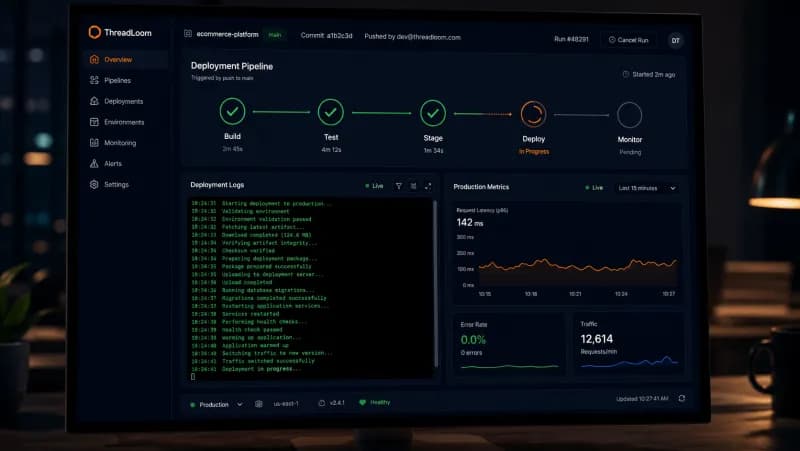
ThreadLoom
The situation
ThreadLoom's marketplace for independent fashion designers went completely offline for 4 hours and 22 minutes on Black Friday 2024, their highest traffic day, with $380K in estimated lost sales. Their infrastructure was a manually provisioned set of EC2 instances with no auto-scaling, a single RDS Postgres instance that maxed out at 800 connections, and deployments done via SSH by their one DevOps contractor who was on vacation during the outage. The board demanded a post-mortem action plan within two weeks and infrastructure that would survive 10x their normal traffic without human intervention.
Technical challenge
The application was a Ruby on Rails monolith serving both the storefront API and admin panel, deployed on 4 manually configured EC2 c5.2xlarge instances behind an ALB with no health checks configured. Background jobs (order processing, image resizing, email sends) ran on the same instances. Database had no read replicas and connection pooling was handled at the Rails level (inadequately). CDN was misconfigured, only 12% cache hit ratio. Infrastructure was entirely click-ops in the AWS console with no IaC. Zero observability beyond basic CloudWatch CPU metrics. Target: handle 50K concurrent users (10x current peak) with automated scaling and zero-downtime deployments.
What we did
Implemented full infrastructure-as-code using Terraform with separate modules for networking, compute, data, and observability, enabling reproducible environments and PR-based infrastructure changes with plan output in CI
Migrated to ECS Fargate with separate task definitions for web, API, and worker processes, each with independent auto-scaling policies based on custom CloudWatch metrics (request latency p95, queue depth, connection saturation)
Deployed PgBouncer in transaction mode fronting a Multi-AZ RDS cluster with 2 read replicas, and implemented application-level read/write splitting in the Rails app, reducing primary database load by 68%
Built a full CI/CD pipeline in GitHub Actions with blue-green deployments via AWS CodeDeploy, automated canary analysis comparing error rates between old and new versions, and one-click rollback completing in under 90 seconds
Set up comprehensive observability stack with Datadog APM traces, custom dashboards for business metrics (orders/minute, cart conversion funnel), PagerDuty alerting with runbooks, and weekly game-day chaos engineering exercises using AWS Fault Injection Simulator
Results
Black Friday Uptime
Peak Concurrent Users Supported
Deployment Frequency
Mean Time to Recovery
Infrastructure Cost (monthly)
CDN Cache Hit Ratio
Technologies
 TerraformAWS ECS Fargate
 GitHub Actions
 DatadogPgBouncer
 PostgreSQL
 RedisCloudFrontPagerDutyAWS Fault Injection Simulator
 DockerCodeDeploy
What impressed us most was their ability to take a logistics vision and transform it into a technology ecosystem. Their work helped us cut manual dispatch and administrative tasks by 50-60%.
Tech stack
Built on what works.




DevOps & Cloud FAQ
Common questions about our devops & cloud services
DevOps & Cloud Resources
DevOps & Cloud Guides & Insights
In-depth guides to help you plan, budget, and execute your devops & cloud project.
Cloud Cost Optimization Guide
Reducing cloud spend without sacrificing performance.
Read guideCloud Migration Guide
Step-by-step cloud migration planning and execution.
Read guideDevOps Best Practices
Modern DevOps practices for reliable software delivery.
Read guideAWS vs Azure vs GCP
Comparing the major cloud platforms.
Read guideBook a Free 30-Minute Call with Us
No sales pitch. Discuss your project, get honest advice, and a fixed-price quote within 4 hours.
Ready to start?
You should never find out about an outage from a customer tweet. Let's fix that.