Infrastructure Management
You are paying for seventeen AWS services. You can name maybe nine of them. Last month's bill was 40% higher than the month before and nobody can explain why. Somewhere in your account, a forgotten EC2 instance is running a test environment from 2023 that nobody uses but everybody is afraid to terminate.
We take ownership of your infrastructure so you can stop paying the confusion tax.
The problem
Sound familiar?
The sprawl nobody owns
Resources launched by former employees. Security groups with rules nobody can explain. Three different load balancers doing the same job because nobody knew the first one existed.
The alert fatigue
Your monitoring sends 200 alerts a day. Your team ignores all of them. When the real incident happens, nobody notices because the signal drowned in noise months ago.
The compliance gap
Your last audit found 47 findings. You fixed 12. The rest are in a spreadsheet that nobody has opened since the audit ended.
The cost bleed
You're paying $3,000/month for resources nobody uses. You know this intellectually. But finding and removing them requires knowledge nobody on the team has time to build.
Our approach
Here's how we fix this.
We take ownership of your infrastructure so you can stop paying the confusion tax.
How we deliver
Our Infrastructure Management Process
Full infrastructure audit
Week 1-2Map every resource, every connection, every cost center. Tag everything. Identify what's orphaned, what's over-provisioned, and what's one misconfiguration away from disaster.
Remediation & right-sizing
Week 2-4Terminate orphaned resources. Right-size over-provisioned instances. Consolidate redundant services. Typical savings: 25-40% on monthly spend.
Monitoring overhaul
Week 3-5Replace alert noise with meaningful signals. Define SLOs. Build dashboards that tell a story, not dashboards with 47 panels nobody reads.
Ongoing management
Ongoing24/7 monitoring with human response. Monthly optimization reviews. Quarterly security assessments. You get a team, not a tool.
Documentation & knowledge transfer
Week 4-6Runbooks for every incident type. Architecture diagrams that match reality. Your team understands what you have and why.
What you get
Infrastructure Management Features & Deliverables
Infrastructure documentation & map
Know exactly what you have and why it exists
24/7 monitoring with human response
Someone is always watching, and will act
Monthly cost optimization reports
Stay lean without the toil of finding waste yourself
Security posture management
Continuous compliance, not annual audit scramble
Incident response runbooks
Any team member can respond to any incident
Capacity planning forecasts
Scale ahead of demand, not in response to outages
Proof, not promises
We've done this before.
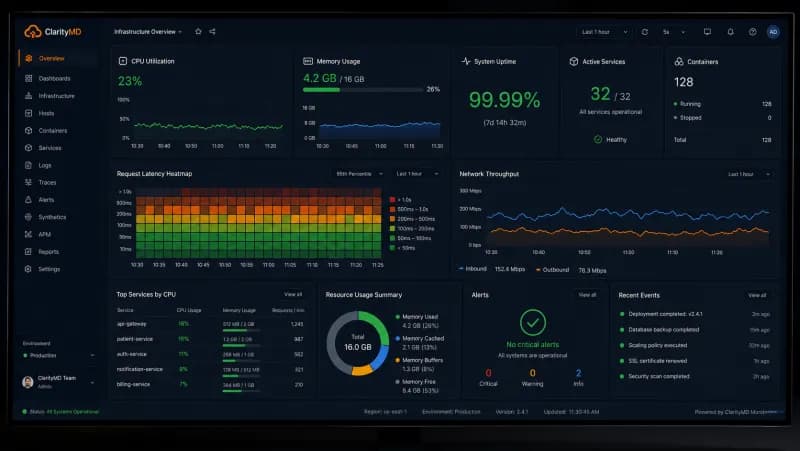
ClarityMD
The situation
ClarityMD provides a telehealth platform serving 2,200 provider practices and processing 40,000 patient encounters monthly. After rapid growth from 2022-2024, their AWS environment had sprawled to 3 accounts with no consistent tagging, 47 untracked EC2 instances (some running services nobody could identify), and security groups with 0.0.0.0/0 ingress rules on production databases. Their HIPAA risk assessment flagged 14 critical findings and their cyber insurance carrier threatened non-renewal. They had 60 days to demonstrate compliance remediation or face losing coverage, which would make them ineligible for most healthcare contracts.
Technical challenge
Infrastructure spread across 3 AWS accounts with no organization-level governance. PHI data was stored in 8 different services including unencrypted S3 buckets, an ElastiCache cluster with no auth, and RDS instances without audit logging. No centralized logging, CloudTrail was enabled in only one account. IAM policies used wildcard permissions extensively (34 policies with Action: *). No network segmentation between environments, dev instances could reach production databases. Monthly AWS spend was $67K with no cost allocation visibility. They needed full HIPAA technical safeguard compliance, documented architecture, and ongoing managed operations.
What we did
Established AWS Organizations with SCPs enforcing encryption, region restrictions, and mandatory tagging, migrated all 3 accounts under centralized governance with separate OUs for production, staging, and development
Implemented network segmentation using Transit Gateway with inspection VPC, restricted all security groups to least-privilege, deployed AWS WAF on public-facing ALBs, and enabled VPC Flow Logs across all environments for forensic readiness
Encrypted all data at rest (RDS, S3, EBS, ElastiCache) with customer-managed KMS keys, enabled audit logging on all data stores, and implemented automated PHI detection scanning on S3 using Macie with alerting for any unencrypted PHI
Built a centralized observability and compliance platform: CloudTrail to S3 with Athena querying, GuardDuty across all accounts, Security Hub with HIPAA benchmark scoring, and real-time Slack alerts for any critical finding
Decommissioned 31 orphaned resources (saving $18K/month), right-sized remaining instances using Compute Optimizer data, and implemented ongoing infrastructure management with weekly compliance scans, 24/7 alerting, and monthly security posture reports
Results
HIPAA Critical Findings
Security Hub Compliance Score
Unencrypted PHI Data Stores
Monthly AWS Spend
Mean Time to Detect (security events)
Cyber Insurance Status
Technologies
 Terraform
 AWS Security HubGuardDutyAWS MacieCloudTrailKMSTransit GatewayWAF
 DatadogPagerDuty
 Prowler
Their structured development process and proactive approach enable us to launch new features efficiently. We saw improved platform performance, security, and search engine visibility.
Tech stack
Built on what works.
DevOps
Other
Infrastructure Management FAQ
Common questions about our infrastructure management services
Book a Free 30-Minute Call with Us
No sales pitch. Discuss your project, get honest advice, and a fixed-price quote within 4 hours.
Ready to start?
You shouldn't need to understand every service in your cloud account. You just need someone who does. That's us.