Project Management
The sprint review meeting. The one where everyone nods along to a burndown chart that's been flat for two weeks. Where '80% done' has meant '80% done' for the last three sprints. Where the real status lives in Slack threads nobody can find and the honest answer is 'I'm not sure where we are.'
We bring clarity to projects that have lost their way, and keep them from drifting again.
The problem
Sound familiar?
The vanishing scope
The project started with a clear spec. Three months later, the spec is a living document that nobody reads and the actual requirements live in the PM's head and seventeen Slack threads.
The accountability gap
Tasks are 'in progress' for weeks. Nobody asks why. Blockers aren't raised because raising them feels like admitting failure. Problems grow in silence.
The timeline fiction
The Gantt chart says you'll ship in March. Everyone privately knows it'll be June. But nobody wants to be the one to say it out loud, so the fiction continues.
The status theater
Standups are status reports nobody listens to. Retros produce action items nobody follows up on. The rituals exist, but the substance doesn't.
Our approach
Here's how we fix this.
We bring clarity to projects that have lost their way, and keep them from drifting again.
How we deliver
Our Project Management Process
Reality check
Week 1We assess where you actually are, not where the last status report says you are. Honest baseline. Clear gap analysis. No sugarcoating.
Structure & rhythm
Week 1-2Establish cadences that work for your team. Lightweight ceremonies that produce clarity, not overhead. The right tool for the job, not Jira for everything.
Visibility & accountability
OngoingSingle source of truth everyone can read. Clear ownership. Blockers surfaced early and resolved fast. No more '80% done' for three sprints.
Predictability engine
OngoingTrack velocity honestly. Forecast based on data, not optimism. Give stakeholders dates they can trust because they're earned, not promised.
Continuous calibration
OngoingRetros that produce real change. Process adjustments based on what actually happened, not what was supposed to happen.
What you get
Project Management Features & Deliverables
Project visibility dashboard
Answer 'where are we?' in 5 seconds, not 50 minutes
Delivery cadence & ceremonies
Lightweight process that produces clarity, not overhead
Risk & blocker escalation framework
Problems surfaced early when they're still small
Stakeholder communication rhythm
Honest updates at a frequency that builds trust
Velocity tracking & forecasting
Dates based on data, not optimism
Retrospective facilitation
Continuous improvement that actually improves things
Proof, not promises
We've done this before.
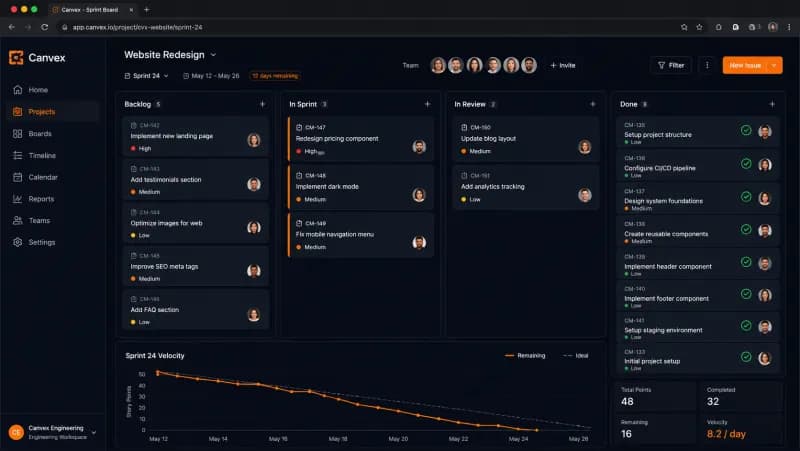
Canvex
The situation
Canvex had missed three consecutive quarterly release deadlines for their enterprise tier, a feature set their sales team had already pre-sold to 14 accounts worth $840K ARR. Engineering was burning out; two senior engineers had quit in the past four months. Sprint velocity had dropped 60% over six months. The CEO described the state as 'everyone is busy all the time and nothing ships.' Their VP of Engineering resigned and the board asked them to bring in outside help to right the ship before committing to a new engineering leadership hire.
Technical challenge
The 18-person engineering team was split across 4 squads with no clear ownership boundaries, tickets bounced between squads averaging 3.2 reassignments before completion. They had 847 open Jira tickets with no prioritization framework, 23 active feature branches averaging 34 days old (some as old as 90 days), and a test suite that took 48 minutes to run and failed non-deterministically 40% of the time. CI pipeline was so unreliable that developers merged to main without green builds. No sprint retrospectives had been held in 5 months. Product requirements were communicated via Slack messages with no formal spec process.
What we did
Conducted a 1-week delivery audit: mapped actual value stream from idea to production, identified 6 systemic bottlenecks, and presented findings to the full engineering team transparently, rebuilding trust through honesty about what was broken
Restructured from 4 overlapping squads to 3 mission-oriented teams (Core Platform, Enterprise Features, Growth) with explicit ownership charters, DRI assignments, and clear escalation paths, eliminating the ticket ping-pong entirely
Implemented a lightweight RFC process for features over 2 weeks of work: one-page design docs with 48-hour async review, reducing mid-sprint scope changes by 85% and giving engineers clarity before writing code
Fixed the CI pipeline by quarantining 142 flaky tests, parallelizing the remaining suite (48 min down to 9 min), and implementing a merge queue, developers regained confidence in the build system within two weeks
Introduced biweekly ship cycles with mandatory demo days, weekly team health checks, and monthly retrospectives, creating a cadence the team could feel and celebrate
Results
On-Time Delivery Rate
Average Cycle Time (ticket to production)
CI Pipeline Duration
Engineering Team eNPS
Open Ticket Backlog
Enterprise Tier Launch
Technologies
 GitHub ActionsNotion
 DatadogSlack WorkflowsLoomPlaywrightFeature Flags (LaunchDarkly)
They demonstrate strong technical expertise, attention to detail, and a deep understanding of how businesses operate. CodeMiners has demonstrated strong project management with clear communication and regular updates.
Tech stack
Built on what works.
 Figma
FigmaProject Management FAQ
Common questions about our project management services
Book a Free 30-Minute Call
No sales pitch. Discuss your project, get honest advice, and a fixed-price quote within 4 hours.
Ready to start?
A GPS doesn't make the drive shorter, it tells you where you are, what's ahead, and when you're off course. That's what we do.